Showing posts with label ground work. Show all posts

Tuesday, August 1, 2017

Important Zoebird Updates!

I know you're all like WHATS ZOEBIRD DOING PRECIOUS.
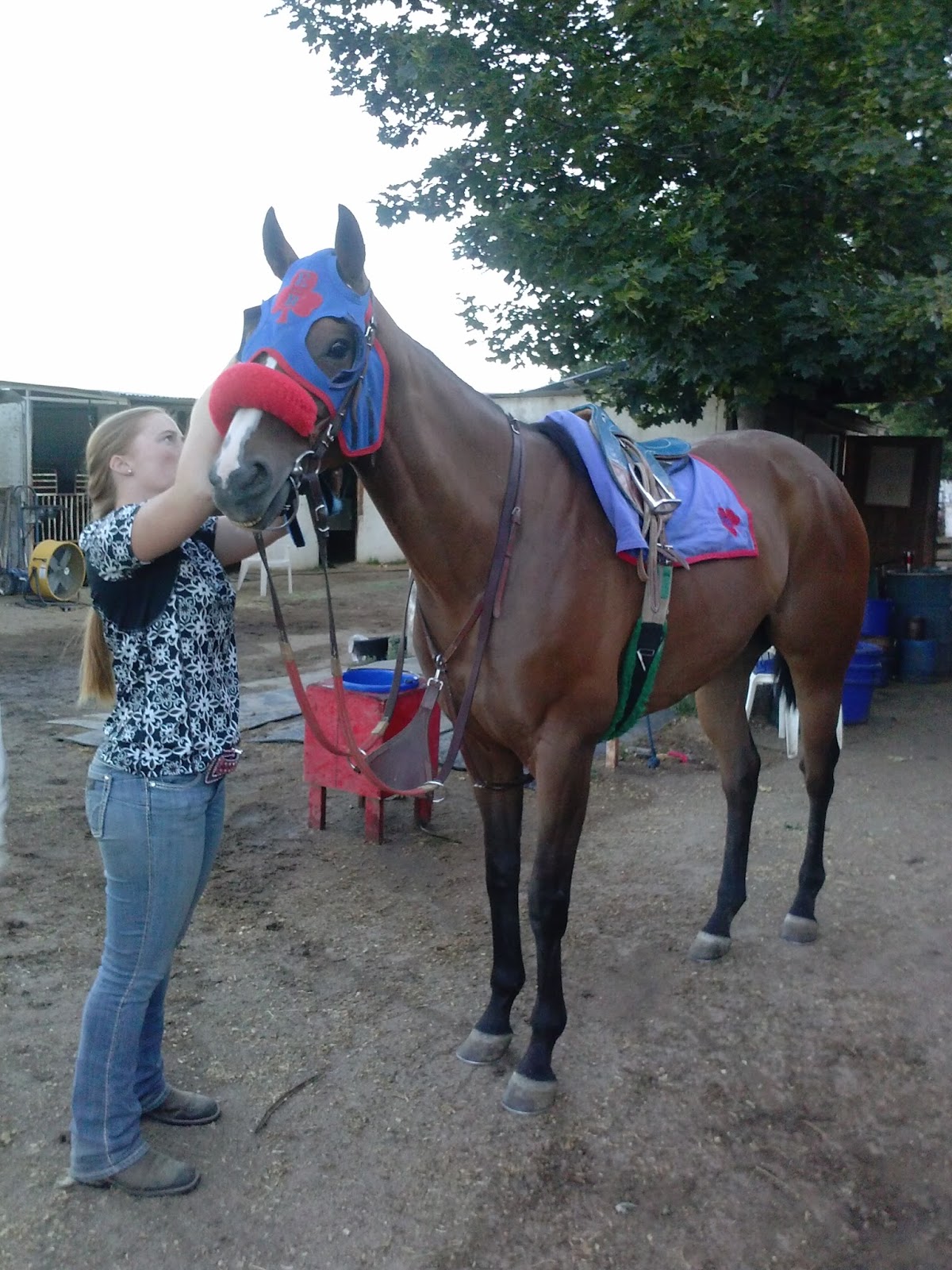
well we're stupidly cute together
Answer: she is featuring in our fantastic new header!! I'd totally throw a blog link to my header person, but she doesn't really blog. Needless to say, she's super talented and no I'm not sharing (but yes she might make you a header for money if you ask real nice and use paypal).

Lots going on in Ms. Zoebird's world! She's settled into the barn routine like a champion, including grazing with her mini me, smoozing all the other boarders, and learning to eat cookies.
long manes, curly tails
She had her first ride this past weekend! I'm so lucky to be on site with a trainer who really gets baby horses and she has a fantastic assistant who has a really great feel for the young ones.
two thumbs up!
ZB was fantastic! Completely relaxed about the whole thing, with not a twitched ear or quick step. They're taking things nice and slow and I'm really excited about it.

While I definitely farm out the backing process, I'm a ground work pro. I pulled out a spray bottle when Zoebird first showed up and it was definitely not her idea of a good time at that point.
everything is better with a smooshy nose on it
I really find this stuff fascinating--Zo has a fabulous brain and she's a real smart lady, but she has to understand something before she's ok with it. I'm sure I looked like a crazy person walking around the round pen, spritzing liberally while she followed me, but once she figured out it wouldn't bite her, she let me spray it in her mane. We're doing a series of slow, simple sessions in a halter, but I'm confident she'll be completely over it in short order.
ooooo look fancy!

Another fun thing we've been working on is cantering on the lunge line--it's something Zoebird was asked not to do for her driving training. I don't want to get after her about it, but she seems pretty comfortable working with me now. On Sunday, we worked on the "canter now" idea, even if she crossfired or only had a few strides before losing her balance.
houston, we have canter!

Yesterday she actually seemed pretty solid on the concept and moved to doing it saddled in the big arena LIKE A CHAMPION OF CANTERING.

These maybe don't sound like huge accomplishments, but to me they're super exciting. I dropped Zoe into a whole new world with a completely different set of expectations and languages and she's adapting like she was born to be a little sporthorse. She meets me at the front of the stall, she makes my heart go pitter pat, and she's exactly what I wanted.

Happy two weeks, little one.

Thursday, April 13, 2017

New Adventures, Part the Second

Courage is a challenge, plain and simple.
but a pretty one
There are a lot of things that are consistent with him though. He learns much better from the ground than in the saddle. He needs me to be calm. He's a thinking horse, so if a concept is introduced clearly and then he gets to think about it, he will be better the next time. He will try for me, but the trying frequently looks like tension instead of Valegro (dammit).

He's also a horse who is VERY tight in his back.

So how do I mechanically explain to him from the ground that I need him to give through his entire topline?

I started by putting him on the lunge in his vienna reins on a 5m(ish) circle. I asked him to come forward and give to the bit at the same time in the walk.

surcingles for lazy days

For my specific horse and his specific conformation, this means AT LEAST tracking at the walk and trot with his neck actively reaching down and his poll comfortably below his withers. 


I really like the lunge line for this stuff--horses learn from the release of pressure, and it lets me release the instant he gets something right. I keep him in vienna reins to limit his range of "leaving" responses. We work in the indoor to limit distractions. Our first session was short and just w/t. 

SEXEH
 Our next session built on the same concepts. Ask him to step up underneath himself on the small circle and stretch down to the bit. The MOMENT he gave me that, I released several feet of line and let him move out to a bigger circle at whatever speed he wanted. Frequently, he'd slow down and think about it vs shooting off.

The picture above shows exactly what I'm trying to achieve--hips lowered, bigger angle in his hind legs than his front, soft through his entire topline. It's just a stride, but this is a weight lifting exercise and he needs time to understand the concept, then more time to get stronger.
ass
 But of course, these things are never easy. After two sessions of like HELLZ YEAH I AM THE BEST TRAINER EVAR, Courage regressed. His go-to evasion is to bend out and push his hips in on a circle, which is essentially just leaning in and giving me no options.

He's not being naughty. He just found a response that I couldn't/didn't correct and since that meant there wasn't pressure, it must be right. I mean. It's the path of least resistance.
not always the path he chooses
Fortunately, I've done pretty extensive ground work with him and have a range of tools available. The next time we addressed the problem, I brought my trusty $9 knock-off carrot stick. Then we did an exercise I learned from watching Tik Manyard teach last year--put the top of the stick on the horse's shoulder and ask them to walk a small circle with the stick as a neutral cue.

This is tricky with Courage. I don't lunge him with a whip because to this point, whips haven't added to the conversation in a constructive way. He's sort of okay with the stick, but likes to overreact to new things to see what happens.

But.
I have an impossible time capturing good media of ground work, so you get this sub-par picture.
 After some theatrics (far less than expected, actually), Courage was ON IT. We started in the walk, with the stick passive on his shoulder. I was careful with my body language--my line of direction stayed slightly in front of him and I kept stepping forward, not back to encourage him to go forward.

First, he got a "stop and take a break" full release for walking calmly with the stick on his shoulder.

Next, he got a full stop and break release for putting his head down while walking.

Then it got tricky--he was tentative about the whole stick thing, so he REALLY didn't want to give through his topline, which he has to do to use his back end correctly. I switched to taking pressure off/giving him a slightly bigger circle to reward the release of putting his head down.

It took a while, but he started to give me the same stretch and engagement in the walk that I had been getting the week before, but now less the "throw shoulder in and speed around" response.
champion genius

Trotting was the next puzzle--I wanted him on a slightly bigger circle but I didn't want to chase him.

However. He's sensitive and the concept was starting to make sense. I was able to put him on more of an 8-10m circle and just point the stick at his shoulder to keep it out. That also transferred well to pointing at his hips to ask him to move them out.

And when we switched to the other side, it was even easier.

That was our entire session for the day. I immediately dropped the stick, pulled the vienna reins, and loosened his girth.

pictured: a different day

This works for him not because I am a ground work goddess, but because I've slowly built it up, piece by piece. A couple times a month, we take a fun day and do simple ground work in a rope halter. He has clear, consistent boundaries and he understands what I'm asking. I try to only add one new skill at a time. It's never about getting after him or wearing him out--it's a way for us to work together and get on the same page.
fanceh
Sometimes we do cool stuff like sending him over jumps. Lately, I've been working more on the push him away/pull him back thing to see if maybe it will help his tendency to be hard to catch.

It may. It may not.

I do like how enthusiastically he participates when he understands what I'm asking. I'm curious to see where this takes us.

And let's be real. I love the challenge.

Thursday, September 29, 2016

On Learning

Part the First

Following the Tik Maynard clinic, I've been doing groundwork with Courage a couple times a week. It's nothing earth shattering. The first few days he was rock solid, then we tried it on a cool, windy, definitely-fall sort of day and he was HYPER reactive and just sort of edgy.
obv need  polos for groundwork
It was really interesting--he presented a lot of the same issues I see under saddle, complete with flailing, leaping, and checking out. We took lots of breaks. He gave lots of releases. By the time I was ready to hop on, I had a calm, focused horse and a very excellent ride.

Part the Second

I'm taking a pilates class. It's all about controlled movement and engaged core muscles. We've started doing some harder exercises lately, which is interesting. In the last session, the teacher asked me to hold my balance with my core and move one limb without shifting weight/balance to compensate for it. I understood what she said and I watched other students do it fairly easily.

And I couldn't.

Could.

Not.
judgmental corgi not impressed
The teacher came over to help me with it and even showed me which muscles needed to contract to make the move happen, and academically, I knew what she was saying. I just. Lacked the capacity to make my body do that thing on that day. We finally settled for me doing a lesser version of the exercise with the idea that I'll practice a lot at home.

Huh.

I love when things are connected, so it was really fantastic to experience that. (Still haven't mastered it. Give me time).
half foamy. i'll take it.
Sure was nice that the teacher was kind, understanding, and clear in her instructions. It would have sucked if she got mad and tried to punish me for trying, huh?

Learning is a fascinating thing.

Tuesday, September 20, 2016

Sinead Halpin & Tik Maynard Clinic Write Up

I had the good fortune to audit a clinic put on by Sinead and her husband Tik this past weekend. They taught at separate arenas in the same facility. I managed to catch several sessions with each and I'll write them up separately.
this is a video still from a video i took, so i'm stealing it
First, Sinead:

She is great. 

Oh you wanted more?

Ok here's what I love about Sinead: she has an amazing ability to read a horse and rider in about 3.5 seconds and then give them very specific feedback on how to improve. She's kind, encouraging, and dead on. I saw nary a tear or a frown and lots of people had ground breaking experiences even in long-term partnerships with established squabbles. I never saw a horse look overfaced or a rider look afraid and I saw lots of good riders get better. If I had a horse that jumped, 10/10 I would ride with her no questions asked. 

Things I did not love about Sinead: um.... really reaching here, but I generally avoided standing next to her because she's freaking gorgeous and I'm just a dumpy old adult ammy who didn't need any contrast there. She was mega nice though and even took a selfie with us after the end of a long day teaching. 
apologies to Alyssa's face
And Tik:

Going in to this clinic, I heard Tik was doing some sort of groundwork thing (?) and I'd watched his winning freestyle from last year's Thoroughbred makeover competition. It was cool, but presented me the same basic problem that I see in most things like that: it has no utility. I don't want to ride around with no bridle. I'm not competing in the "follow the leader" olympics, and frankly, I don't have a horse that would excel in the makeover context so like... good for you? 
i both staged and took this photo, so i stole it from lindsey
But. Give the man a chance, right? 

I attended his lecture Friday evening before the riding started. When I arrived, he was talking about Pat Parelli and Clinton Anderson and Tom Dorrance and Jonathan Fields and again, good for them and they are certainly capable of affecting good change with horses, but all of those people live(d) in the western world, and so ultimately what they're getting horses to do is not something I'm super interested in. Besides, while I've never so much as dabbled in the natural horsemanship/western world, I have come up around a bevy of excellent horsemen in the english world. So? 

But here's the thing: when I attended the Mustang Makeover this summer, I realized that all these 100-days-off-the-range horses were doing something my horse simply was not capable of. He couldn't stay with me for a simple dressage test at a show with minimal distractions and here these semi-broke feral horses with no history in front of crowds performed well. I wanted something from that, but again, I have no interest in riding my horse into the back of a truck or shooting guns off his back or riding over a teeter totter (all actually things that happened). Like... nice idea, but not super useful to me. 
did want this horse. Alyssa said no. Bank account sided with her.
And then Tik moved on from talking about the showmen of the natural horsemanship world and said something that gave him my 100% full attention. It was along the lines of "If I had to quit riding tomorrow, but could still work with horses from the ground, that would ok because I'm less interested in technique and more interested in the philosophy of how a horse learns." 

BAM. Hello. Now we're speaking a language I want to learn. 

He went on to explain a simple progression: As horse lovers, we start by learning riding technique from our trainers. Then we try to incorporate theory. As we improve and ride on our own, we develop instinct to deal with situations. Many people stall out there, which is fine but the next step is the philosophy of training. Asking no longer "how", but now "why" and understanding how to motivate horses. 

After all, as he pointed out, "People tend to confuse motivation with intelligence. Your horse isn't stupid. He's just not interested in trying for you." And also, "The better communicator you are, the less motivating you have to do." 
tell me more
The next morning was all that and more. 

As he worked with different people and their horses, he continued the conversation. He talked about always starting from a point of success for the horse--catch them doing something right, if you will. He explained using your body language to communicate with horses. This wasn't super new information to me until he added the part about where you place your line of direction. 
excellent paint graphic by me
It made so much sense--he was having handlers do #6 to get their horses to back away from them with progressively less stimuli, but then when he asked them to walk up and pet their horses, the animals shied away. Why? Because horses aren't afraid of predators. They're afraid of predatory behavior. When the handlers learned to use #5 to approach their horse and arc their line of direction so it was not through the horse, they stood solid. (Also changing body language obv). 

But this wasn't a how-to of simple natural horsemanship techniques. He summed it up very well when he used the term "thinking laterally". Humans tend to think in linear terms. This, then that. Horses don't usually. So if you try this, but don't get to that, you need to be mentally flexible and think laterally. What are other approaches? How can you break this down in steps that your horse will understand? 

There was another exercise--asking a horse to trot in a small circle around it's handler, keeping it's shoulder about 4' away. The lead line was short enough to encourage that, then the handler held a stick at hip height to keep the horse from encroaching on the space. This was a moment of truth for a lot of pairs. The exercise itself wasn't really the point--there is no prize for trotting tiny circles. The exercise was 1) to highlight problem areas in handling and 2) to teach the horse how to learn. 
Problem areas were simply--many handlers gave ground to the horse and back up, allowing the horse to push them around the space. Horses frequently overreacted to the sight/feel of the stick. Most of the horses had one side that was ok and then had meltdowns about the other side. 
we tried it later at home
There was so much going on here--the handler needed to be very, very clear with their body language what they wanted the horse to do. It was critical that they kept stepping towards the horse. This made the circle bigger so it wasn't hard on the horses, but it also established who was pushing who out of whose space. They had to really figure out their line of direction--obviously if you push straight into the horse, it blows sideways (if it's even listening to you), so you needed to establish your space and step in the direction you wanted to go.

As the horses learned, Tik emphasized that at the beginning, there needed to be no right or wrong answer. First they just needed to be rewarded (with a release of pressure/break/treat/whatever) for trying, then gradually you could introduce a harder answer and an easier answer. Basically, don't punish the try especially as the horse begins to learn. You want them to work with you, not fear you. 
basically the bible for this horse omg
This exercise also introduced the idea of the same stimuli meaning multiple things. He'd alternate holding the stick at steady hip height to keep the horse away and setting it on the horse's back/neck/withers and asking the horse to ignore it. Again, a question of communication and trust. 

As Tik explained it, he's not doing groundwork for groundwork's sake. What he wants is to work with a horse until he gets what he calls "the look"--not just licking and chewing, but the horse giving him an intelligent look saying "we're here together. What are we doing next?"

If you never do groundwork again after that moment, that's fine. You always need to feel like you can get that expression if you need to though--that's what tells us the horse is mentally with us. That trust is what everything else is built on. It's not about the follow-the-leader olympics--it's about becoming the leader that your horse looks to so that you can progress together.
plus adorable
What I loved most about learning from Tik Maynard as a clinician was his emphasis on learning how a horse learns and then using lateral thinking to teach the horse in a way he can understand. As an under saddle clinician, he was fine, but his abilities to understand the way a horse thinks and encourage his students to be mentally flexible was where he really shone. 

I didn't sign up for this clinic because I thought it was all jumping, but now that I've watched, let me assure you, Courage will be first in line for a session with Tik next time we get a chance. 

PS He also highly recommended books by Mark Rashid, who is basically my horse training idol, so that was awesome.

PPS I apologize if this is drivel--my mind is still pretty blown and I'm severely sleep deprived while writing it.

Wednesday, April 6, 2016

Overthinker's Dilemma

One of my personal/horse goals for this year is to stop overthinking everything. As a big time overachiever with an addictive personality, that is SO HARD for me and SO BAD for my riding. You have no idea how fast I can go from "I can't catch my horse" to "my trainer just caught my horse" to "my horse hates me" to "obviously I am a bad person" to "I should get Netflix instead of horse and eat Cheetos until I die by myself in a cave".
obviously
But guess what?

That is dumb.

The reasons Courage is sometimes hard to catch are many, but none overly complicated or personal. He doesn't hate me. He isn't having some weird health crisis. He's just a horse in the spring who sometimes needs boundaries and the reason my trainer could catch him was that he thought she was feeding him, which was mildly more entertaining than the weird game he was playing with me.
bad boy halter was busted out
It's the same under saddle--if he spooks or flails or scoots or leaps, instead of going "scary-->bad-->death-->no-->sell horse-->cry", I just ignore it and keep on riding in the moment.

It makes sense (yes I'm overthinking not overthinking things. you're welcome.) because Courage is a horse. Horses live in the moment. They react. They don't think ahead or make plans. He may be kind of an asshole a lot of the time sometimes. He's not capable of conceptualizing hate or horse show plans or goals or the training pyramid, and what's more, he wouldn't care if he was capable. He's too busy living in the moment.
the moment where i bought ANOTHER halter
If I'm going to get through to him, I need to be living and breathing in that same moment. Not six jumps ahead, not crashing and burning my goals for the year, and definitely not deciding which texture of Cheetos I want to be found dead with. Also not fixating on the fact that _I_ couldn't catch him, but someone else could. It's in the past. He's not thinking about it, and if I am, I'm missing out on what's happening right now.

It all makes perfect sense, right?
humor me
It's hard because of the obsessive/type A/perfectionist thing. Instead of constantly rerunning the mental tape of Courage walking up to my trainer with his ears pricked, I take a deep breath and focus on what I am doing right now in this moment (blogging). I remember that bringing emotional baggage to the barn with me absolutely WILL sabotage my relationship with Courage. I know that if I come each day with an open mind and stay in the moment with Courage, I will get through to him and things will get better.

So yeah. Things are not all roses. Sometimes my horse is impossible.

And I am zen (usually most of the time but it's getting better I swear).
this helps zen a little
PS and yes I totally obsessed over this a lot and talked with people who know us and whose opinions I trust and YES I have a plan and NO he isn't dying (at all) or getting sold (despite a few threats).

PPS and that's not to say the cheetos option doesn't come up 1-4 times a week depending. I'm just trying to dwell on it less.

PPPS and also I'm very anti-negative-goals. In general, I say "I want to look up" instead of "Stop looking down", but in this case, I don't want to redirect the energy. I just want to kill it in it's tracks. BAM STOP NOW.

Thursday, February 25, 2016

Putting on the Polish

As Courage and I start finding our stride together, I keep having these odd moments of like "aawwww he's so cute and I loff him" and then I just want to send cute pictures of him to everyone I know (like, more than I do usually) and gush about him. That's new for me with him.

Courage is a hard horse to love and I'm a person who doesn't connect easily. I suspect y'all can kind of tell--I keep posting things about how we're building a relationship, but then we never seem quite "there", in that smitten, forsaking-all-others type of way. And I get that not everyone has to have that connection with every horse, but I really, really miss it.

To me, a relationship with a horse needs two things: adventures and down time. Last year, we kick-started adventure time with horse shows and satin and fun pony weekends. We never really addressed the quiet down time part though. Every day was focused on achieving specific goals in the saddle, which was fine. It just meant that I spent my time DOING WORK with him and none at all appreciating who he is.

I love grooming. I always have. It's a time and a place for me to connect with my horse and really learn to appreciate them inside and out. It's a way of staying on top of bumps and bruises and really being in touch with my horse on an intimate day-by-day basis.

Courage has actually gotten a lot more amenable to grooming than he ever was before; he used to just stand in the cross ties and alternately lift his hind legs and threaten if anyone BREATHED on him. Now while he'll still kick you into next week if you dare to use anything so barbaric as (gasp) a RUBBER CURRY, he's sort of okay if I whisk off the dust briefly with his special soft brush. He has great nutrition and great coat genetics, so it works for us.

He doesn't like it. I'm a busy working ammy. We're chasing bigger goals together. Grooming is something we've been skimping on the whole time Courage and I have been together.

The more I thought about it, the more I realized I was selling both of us a little short. Courage doesn't hate grooming--he's just very sensitive. He objects to odd things, sure, but he's not unwilling to be touched anymore, the way he was when he first came home. I've carried over my reaction to his prejudices even when the prejudices are mostly gone.
racehorse Courage
But now, I need to do better. We're working our way through the skulduggery that is the foundations of dressage and that shit is HARD and pretty much EVERYONE on the ENTIRE PLANET is better at it than we are. That's sad and depressing and makes me seriously question why I'm even trying, especially when I know that my sensitive, complicated horse sometimes usually pretty much always  makes things harder than they need to be.

I keep reminding myself that it's about my journey with this horse, and that I do like him, and since dressage will always be a fickle mistress and we might never be good at it, we need to find other ways to connect and enjoy each other until such a day as we (maybe) suck (somewhat) less.
so. hard.
And that's where grooming comes in. Quiet time spent together. Curving muscles and soft brown eyes, velvety noses and long, thick tails. We find the time to spend together so I can appreciate the horse he is, with all his sensitivities and quirks and oddness. His deep-seated hatred of jelly scrubbers doesn't mean he can't have nice things. It just means I need to personalize what I use with him.

I finally got around to ordering some highly recommended extra-soft brushes. I reorganized my grooming kit and took out all the things I know Courage hates. I'm creating a real grooming routine for us. It's slow and methodical. I listen for what Courage likes and pay attention to what makes him uncomfortable. I think I've even finally found a place for that goofy sheepskin mitt Cuna won at a show years ago--a certain bay princess thinks it's the perfect finishing piece.

There's no question in my mind anymore that Courage is my horse and he's staying with me. It's time to invest in the quieter side of our relationship.

(Besides, he needs to be super shiny for when I take dorky pictures of him to send to all my friends.)

Friday, November 22, 2013

Friday Fun Challenges

Trapped inside

If you obsessively stalk my blog, it's possible that you remember the time Courage had a bad day, all because he was completely incapable of stepping over an obstacle that was 12 inches high. Never mind that he doesn't bat an eye when he jumps twice that height--it is completely impossible to be led over a tiny obstacle.

I kept meaning to work on that at home, but it's so ridiculously stupid that I just put it off. I mean, his ground manners are great. I can lead him with just body language and he has no problems going forward. I kept meaning to lunge him over some little stuff and gradually work up to leading him over it (yeah, how backwards is that?), but I just didn't make the time.

And then I wanted to clip him. The BO warned me that closing the roll-down front door of the barn can be pretty spooky for horses already inside the barn, so I closed it before I got him out of the field and then just led him in through a stall.

His cute little face was right by my shoulder as I walked into the stall and then all of a sudden, it wasn't.

I'm standing in the stall. He's still out in the run. There is a HUGE AND TERRIFYING OBSTACLE between us.

Yes, he had to step over a 6" tall board to get into the stall.

Now, we can argue that there is a light/dark change* and it's a new environment and WHATVER, but the fact is that he lives two stalls down in the EXACT SAME BARN. Yeah, his stall is just a step up without a little board to step over, but I'm not buying it.

Of course, I'm dealing with a very athletic and expressive horse. I can't ask the lovely couple taking care of their 26 year old retiree to come over and kick my horse in the rear because if he were to express himself, I wouldn't want them getting hurt. The BO is in the house and very, very sick, so I really don't want to call her either.

It's just me and C-rage. Not going in a stall.

Great. I cannot be both behind him for encouragement and in front of him for guidance. I do know that he would do almost anything for a cookie. I grab a whole hoodie pocket full of cookies and try bribery. I think all four of his feet got within about 12 inches of each other and his whole neck was stretched into the stall, but he didn't care even try to step in.

I tried clucking and pulling. I tried giving him time. I made it very clear that I wanted him in with me. I opened the front stall door so it wasn't claustrophobic. I established that he can stretch his neck out a very long way and that he was trying very hard, but he just. wouldn't. do. it.

Finally, I leaned out of the stall, picked up his left front leg, and set it inside the stall with me. Then I backed up and held out a cookie.

The impossible horse trap
He looked around and walked right in. I praised him, gave him pats and scratches, stuffed him full of cookies, and walked in to the barn aisle.

The little blazed face was suspiciously missing.

Yep. There was another board to step over.

This time, I got him over in about a minute. He was very suspicious of the hoof lifting technique, since the last time I did that, he some how ended up levitating into a magical horse trap.

That said, he really, really wanted the cookies.

He had to think about it, but he finally made the step into the aisle.

Of course, it remains to be seen if he would have gone in at all if he knew that I was about to clip stars on his butt. ;-)

*Also there was no light/dark change when he first pulled this stunt. We were outside on a sunny day with safe footing.

Monday, August 5, 2013

Making the Transition

I had the unique advantage of working with Courage (and a whole barn full of horses) at the race track before I brought him home. I highly recommend this route to anyone looking to snatch up their own OTTB--I've spent days handling him hyped up on grain and hay and know a lot about his reactions to stimuli. That said, most people have "lives" and "real jobs" and "mortgage payments", so I realize it isn't always an option. For those of you looking at bringing home an OTTB of your own, here are some thoughts on the transition from someone going through it for the first time.

 At the Track
Typical morning routine
I met Courage at the track. He's old for a racehorse (2005), so he's pretty well set in his ways. That said, he was on a normal racing diet of INSANE amounts of grain (seriously, have to see to believe) and lots of alfalfa. This high energy diet is what it takes to fuel a high efficiency athlete like he was, but it also affect the horses personalities. 

Several of the younger horses seemed a bit nuts, but I'm pretty sure that if they ate a regular sport horse diet, they would have calmed right down. Instead of focusing on that behavior, I looked for patterns that indicated personality in the various horses. This is Courage getting ready for a morning work. He's out of his stall, but he's quietly standing while he gets ready.

His exercise rider would drop his stirrups and ride on a long rein to and from the track while Courage walked along calmly. He knew when to run and when to rest. 

Good morning fans
After a bath, his next stop was the hot walker. Due to space constraints in a racetrack environment, turnout is rarely available. This is basically the next best thing. The horses are able to cool out and dry off while getting some exercise. Some of them take the opportunity to bounce around like nutters. Some walk calmly. Most are somewhere in between.


WHOA BUDDIES. Break time.

Some think that the most fun game is to make the walker (and all the other horses on it) stop repeatedly.

It's probably passive aggressive, but it's a very calm way od expressing it.


Om nom nom
In the stall, Courage was easy to be around and respectful of people's space. The trainers, grooms, and riders have no interest in getting hurt, so they are pretty particular about manners. A very talented young horse might have more leeway, but generally the older the horse, the better they are to be around, much like horses in every other part of the world.

Another trait I liked about Courage in the stall was that he was an excellent eater. Given the massive caloric intake the horses are offered every day, they can afford to be picky. Some ate primarily grain. Some picked out only the best scraps of hay. Courage pretty well cleaned up all his hay every day. That means that he is a good eater (yay! easier to put weight on) and that his gut feels quite comfortable digesting. Perfect.

Just a photo shoot. Move along.
Even when we threw him for a loop by playing dress up and going in and out of his stall at an unusual time, he was pretty unfazed. It wasn't part of the usual routine, but he was a confident enough horse that changing the routine a bit wasn't a cause for drama, crankiness, or nerves. 

Instead, he enjoyed the attention and exhibited his social side. 

What a horse does on the actual racetrack doesn't necessarily translate to how he'll behave as a sporthorse. How he is to deal with on the ground, in the stable, and around the barn is more what I'm concerned about. 

Courage impressed me. 


At the Barn
Exploring
When I introduced Courage to his new barn environment, I was aware that it was a whole new world for him. He was turned out last winter, so I know he's got some basis for understanding, but I doubt he's every lived in an average sporthorse set up with daily turnout, a stall and run, and light work. I know that he's used to a structured routine and he likes watching what is going on.

As such, I immediately got him on a routine and made sure he had a stall where he could see everything. He's used to activity (and watching the races go by) and he loves attention. The BO and I were careful to follow the routine, putting him on his drylot when the horses went out, feeding at the same time, and bringing him in with the other horses. 

It was easy to understand and he's a smart guy, so he settled right in. 


Om nom nom
Some things were all new to him, like grass pastures and social interactions and metal fences. I tried to introduce those things slowly. He picked up on pastures pretty quickly--he LOVES grass.

That said, he isn't used to eating it for long periods and he isn't sure about wide open spaces. We started out handgrazing. I'd let him go once he seemed settled and bring him in as soon as he seemed uncomfortable. Yesterday he went 2.5 hours with minimal supervision and did great.

He still eats all the hay we give him (though he prefers to eat at night) and has adjusted very well to having a complete feed instead of oats every day. I don't have him on any supplements, but if/when I decide to add them, I don't think it will be a problem.

Not so sure

Other things were harder. He did ok the first day with having the retirees over the fence and learned about how to say hello and make friends. It's something he's done before, but it's not an encouraged behavior at the track.


Of course, it can't all be smooth sailing. He managed to find the one sharp place on the fence (that we can't find again, of course), and cut his leg up impressively.

It's important to remember that he's used to being handled every single day and he's used to minding his manners. My BO was able to catch him and cold hose and wrap without the benefit of cross ties, all by herself. He's used to being taken care of and he's used to behaving. To him, there was nothing weird about the situation other than that the fence bit him. 

 Taking care of his cuts and scrapes was as good a time as any to introduce him to crossties. I needed him to quit playing with the shampoo in the wash rack and I knew his clever mind and quiet personality were on my side.  The first day I used one cross tie and reminded him not to walk forward in the three sided wash rack. The second day I used both ties and kept the lead rope handy. He never made so much as a peep and now cross ties very well.

What's not to love?
After just a little more than a week as an OTTB, Courage is doing very well in his new life. I'd say his manners at the new barn have very accurately reflected how he behaved at the track. Because he was handled well, he's had a very easy time adjusting to the sport horse life.


Fancy!
I want to do more with him under saddle before I say too much there, but let's just start by mentioning that his reputation as a runaway on the track has absolutely nothing to do with the chilled out, mellow guy I see every morning.


Related Posts Plugin for WordPress, Blogger...